Product & Updates
What We Mean by “AI Front Office” - And What We Don’t
"AI" gets thrown around a lot in healthtech. Book Health approaches the front office as a set of clinic-specific document, outreach, and voice workflows that should keep people responsible for review.

"AI" is one of the most overused words in healthtech right now. Many software vendors have added it to their pitch decks. Plenty of EMR companies describe themselves as "AI-powered." And it seems like every week a new startup announces they're using artificial intelligence to transform healthcare.
A lot of the time, it's marketing. A rules engine with a chatbot on top. A template system that auto-fills forms. An analytics dashboard that someone decided to rebrand as "intelligent."
We're not interested in that game. At Book Health, when we talk about designing an AI front office for Canadian healthcare, we mean something specific. This post is about what that means in practice: how we think about the front office workflow, where automation can help, and where humans should stay in the loop.
Three Areas of Front Office Work
We think about the front office in terms of three areas of work. Each one maps to a distinct part of the day-to-day workflow in a Canadian clinic, and each is a candidate for planning and clinic-specific implementation assessment.
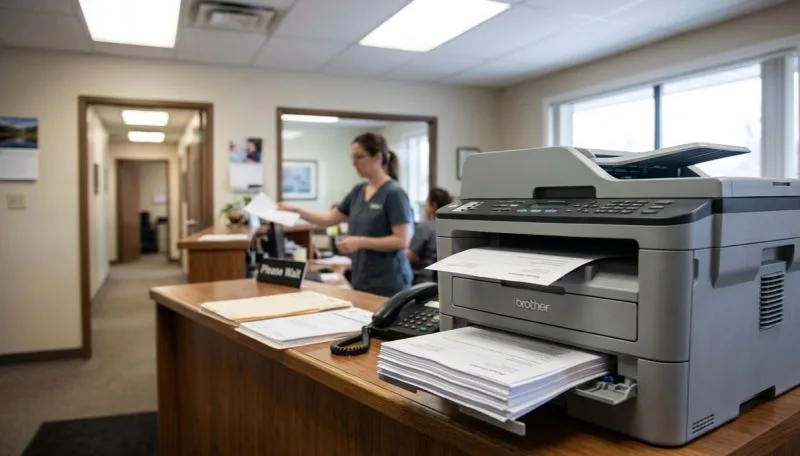
Incoming documents. This covers everything that arrives at the clinic: incoming faxes, referrals, lab results, insurance documents, pharmacy renewal requests, and patient records. The goal is to read, classify, extract, and route this information. If a faxed referral arrives early in the morning, the aim is to have it classified and the relevant patient data organized so staff can act on it quickly rather than starting from a stack of unsorted paper.
Outbound outreach. This covers everything that goes out: patient outreach, appointment confirmations, follow-up reminders, recall campaigns, and prescription renewal notifications. When an incoming referral is processed, the next step may be reaching out to the patient. A clinic could also assess whether approved reminders or staffing messages fit a defined workflow. Channels, language coverage, consent, and system access would be part of implementation planning.
Voice. This covers everything that comes in by phone: answering inbound calls, understanding what the caller needs, and either resolving it directly or routing it to the right person. A patient calling to book an appointment, a family member asking about visiting hours, or a staff member calling in about an absence are all examples of routine calls that a well-designed workflow could help manage.
Together, these cover the three primary channels of front office work: documents, outreach, and voice.
What "AI-Powered" Would Mean Here
Let's get specific about the technology, because this matters.
Document processing of this kind can combine optical character recognition with vision-language models. These are AI models designed to look at images of documents, including scanned faxes, handwritten notes, and forms with checkboxes, and extract structured information from them. The aim goes beyond keyword matching or template recognition: the intent is for the models to work with clinical context, distinguishing a referral from a lab result, identifying patient demographics across different document layouts, and flagging when critical information appears to be missing. In practice, accuracy and behaviour depend on the specific documents and workflows involved, which is why we treat this as something to assess per clinic.
A voice workflow can use real-time speech-to-text, natural language understanding, and text-to-speech. The goal is for the system to listen, interpret the intent, and respond conversationally rather than playing a phone tree. Language coverage and call handling are part of what would be scoped during implementation planning for a given clinic.
An outreach workflow could be designed to coordinate approved communication across SMS, phone, or email. For example, a clinic might assess a follow-up sequence after an unanswered message. Any schedule update or other write action would depend on verified access, clinic rules, and human oversight.
The intent is for these workflows to write back to the EMR rather than create separate systems or extra dashboards that staff need to check, so information shows up where staff already work. Which EMRs a workflow can connect to, and how, is something that would be determined during clinic-specific implementation assessment and deployment planning.
Where Humans Stay in the Loop
This is the part that matters most, and the part that a lot of AI marketing underplays.
We believe in a simple principle: AI can help process, humans should approve. Any front office workflow we design is intended to include a human verification step for decisions that affect patient care, with human review and configuration subject to deployment planning.
When a document is classified and data is extracted, the proposed output should go into a review queue. A staff member, such as an MOA, a nurse, or the physician, would review the information before any approved next step. This is a design principle for implementation planning, not a claim that a particular write-back connection is currently available.
This is especially important for higher-stakes workflows. Consider a physician's dietary order arriving for a patient in a care facility. A workflow could extract the order details and check them against the patient's recorded allergen profile, and if there appears to be a conflict, surface it and escalate to a nurse or dietary manager for review. The intent is not to override clinical judgment, but to surface information faster and help catch conflicts that a busy human might miss. Exactly how such checks behave would be defined and validated during implementation.
For voice calls, the goal is to resolve routine inquiries such as office hours, directions, and appointment availability, while transferring complex or sensitive calls to a human. A patient calling about a clinical concern should be routed to the appropriate staff. A family member with a complaint should be connected to the administrator. The voice workflow is not meant to act as a clinician; it is meant to help handle routine reception tasks.
A useful way to measure this is the "escalation rate": the share of interactions the workflow cannot resolve on its own and hands off to a human. A sensible design target is to keep routine, self-service inquiries flowing while making sure the calls that should go to a person get there quickly, because the routine queue has already been handled. Actual rates depend on each clinic's call mix and configuration.
What We Don't Do
Clarity about what we don't do is just as important as what we do.
Proposed workflows are not intended to provide clinical decision support. In clinic-specific planning, Book Health focuses on administrative workflows; diagnosis, treatment recommendations, and clinical judgments remain with clinicians. The aim is to evaluate operational work such as moving paper, scheduling appointments, filling shifts, and answering phones without moving clinical decisions away from clinicians.
We're not trying to replace staff. The goal is to evaluate whether repetitive administrative work can be reduced while staff retain responsibility for judgment and exceptions. Any time returned to staff would need to be measured in the clinic's actual workflow rather than assumed.
We work with existing systems. Our approach is to design workflows that work with the systems clinics already use. If a clinic has specific scheduling logic, such as certain providers only seeing certain appointment types on certain days, the intent is to encode those rules and follow them. The specifics of any integration are part of clinic-specific implementation assessment.
We take Canadian data protection seriously. Data handling, residency, and privacy are central to how we plan any deployment, and we design workflows with Canadian clinics and their obligations in mind. The exact data-handling arrangements for a given clinic are defined during deployment planning.
The Bigger Picture
We're thinking about the AI front office at a specific moment in Canadian healthcare. The workforce pressures are real: staffing gaps, burnout, and a heavy administrative burden on healthcare workers. At the same time, the technology to assist with front office work has matured, and the environment for digital health adoption in Canada continues to develop.
The point of an AI front office is not to be a buzzword. It's a way of thinking about the operational layer of a clinic, planning workflows around documents, outreach, and voice, and assessing what makes sense for each specific clinic, with humans kept in the loop.
That's what we mean by "AI front office." Nothing more, nothing less.
Availability note: The workflows and capabilities described here reflect how we approach front office automation and are subject to clinic-specific implementation assessment and deployment planning. Features, integrations, and timelines may vary and are not guarantees of current availability.