Clinic Operations
Why Canadian Clinics Are Still Drowning in Faxes - And What AI Can Do About It
Fax remains central to many Canadian clinic workflows. Here is how teams can evaluate document processing, human review, and EMR integration planning without adding another disconnected queue.
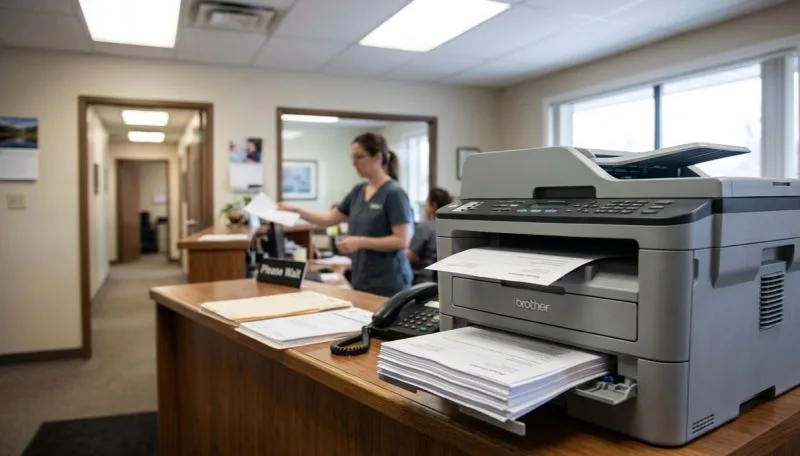
Fax remains one of the most common ways clinical documents move between Canadian providers. If that sounds like it belongs in 1995, you're not wrong. But in Canadian healthcare, the fax machine isn't a legacy artifact - for many clinics it's still the backbone of clinical communication.
Referrals come in by fax. Lab results come in by fax. Prior authorization responses, specialist consult notes, pharmacy renewals, insurance documents, and patient records - all faxed. Every single day, medical office administrators across Canada sit down in front of a queue of incoming documents and begin the slow, manual work of reading, sorting, classifying, and entering data into an EMR that was never designed to talk to a fax machine.
This is the reality of the Canadian healthcare front office today. And for many practices, it's where one of the biggest operational bottlenecks lives.
The Anatomy of a Fax Workflow
Let's walk through what actually happens when a fax arrives at a typical Ontario family medicine clinic.
A referral comes in from a cardiologist's office. It's a scanned PDF - sometimes clear, sometimes not. The MOA opens it, reads through the document to determine what it is, identifies the patient, and checks whether they're in the system. Then they classify the document type, extract the relevant clinical details, and manually enter that data into the EMR. If information is missing - and it often is - they call or fax back to request it.
This single referral can take several minutes of focused attention. Now multiply that by the many faxes arriving every day. A mid-size clinic with several physicians can receive a high volume of inbound faxes each week. The math gets difficult quickly. Staff fall behind, documents pile up, and patients wait.
Why Canada Still Runs on Fax
The natural question is: why hasn't this been solved already? The answer has several layers.
First, fax is deeply embedded in the regulatory and operational fabric of Canadian healthcare. Many provincial systems, hospital networks, and specialist offices are set up to communicate via fax because it was, for decades, considered the most secure and universally accessible method of transmitting health information. Changing that requires coordination across thousands of independent organizations - and that kind of coordination doesn't happen quickly.
Second, the Canadian EMR landscape is fragmented. Clinics may encounter systems such as Accuro, OSCAR Pro, Telus PS Suite, PointClickCare, and other platforms with different interface and procurement requirements. Any interoperability or integration option needs to be verified with the clinic and vendor for the specific environment rather than assumed from a platform name.
Third, and perhaps most importantly, the alternatives haven't been good enough. eReferral platforms exist, but adoption is uneven. Many specialists still prefer fax because it's what they know and it works with their existing setup. The system won't change overnight, which means any solution needs to work with fax as it exists today, not as we wish it were.
What AI Document Processing Actually Looks Like
This is where AI-powered document automation enters the picture - and it's worth being specific about what that actually means, because the term "AI" gets applied to a lot of things that don't deserve it.
Modern document processing can combine optical character recognition (OCR) and language or vision models to help prepare incoming documents for review. A clinic-specific implementation would need to validate the document types, accuracy thresholds, escalation rules, and permitted system access before use. A potential process could work in stages.
When a fax arrives, a proposed workflow could first convert the scanned image into readable text. This is the OCR step. Performance can vary with handwriting, checkboxes, scan quality, and multi-page documents, so clinics should test representative material rather than rely on a general accuracy claim.
Next, a model could be evaluated for document classification. Is it a referral? A lab result? A prior authorization response? A pharmacy renewal request? A records request? Each document type has a different workflow, and uncertain classifications should be routed to a person.
Then comes extraction. A planned workflow might prepare relevant fields such as patient name, date of birth, referring physician, diagnosis, requested procedure, medications, or insurance information for human review. Clinics should validate performance on their own document mix because terminology, layouts, and scan quality can all affect results.
Finally, reviewed data could be prepared for the clinic's next step, such as notifying staff, scheduling follow-up, or flagging missing information. Whether anything can be written into an EMR, and under what controls, depends on clinic-specific integration assessment, vendor support, privacy review, and deployment planning.
The goal is to reduce repetitive handling while keeping a person responsible for the output. Clinics should establish their own baseline and measure any time or quality improvement during a controlled implementation.
Why Canadian Clinics Stand to Gain the Most
Many healthcare automation products were designed first for other markets. Canadian clinics should not assume those products fit their EMR, provincial privacy obligations, or local workflows. Each product and connection needs clinic-specific verification.
That gap is the opportunity. Canadian clinics often operate on tight margins. They can't easily hire additional staff to manage growing fax volumes, and billing rates don't always keep pace with operational costs. The Canadian privacy environment - including frameworks such as PHIPA in Ontario and PIPEDA federally - also means manual document handling carries operational and privacy considerations that clinics need to manage carefully. Clinics should assess their own obligations with appropriate advisors.
A well-controlled fax workflow may reduce repetitive handling, make exceptions easier to see, and help staff spend more time on work that requires judgment. Those are evaluation goals, not guaranteed outcomes, and should be measured against the clinic's starting point.
The technology has matured, and there is growing public investment in digital health infrastructure. Ongoing workforce pressures across Canadian healthcare make it worth exploring whether automation can take routine document handling off your team's plate.
What We're Building at Book Health
At Book Health, we are exploring this workflow through clinic-specific planning: reading incoming faxes, classifying documents, preparing structured data for review, and defining where people approve or escalate the work. The exact capabilities, controls, and system access would be established and validated before deployment.
We're actively researching and planning integrations with Canadian EMRs such as Accuro, OSCAR Pro, Telus PS Suite, and PointClickCare. These integrations are at the planning and research stage rather than generally available, and integration availability is assessed with each clinic before any deployment. Nothing here should be read as a claim of a live, connected, or certified integration with any named system.
The goal is not to eliminate the fax machine. It is to evaluate whether a more accountable workflow could reduce the time teams spend reading what comes out of it.
If your clinic is spending more time processing paperwork than caring for patients, that's the problem we exist to solve.