Product & Updates
Why Voice AI Is the Next Frontier for Canadian Clinics
Phone demand can overwhelm clinic teams during peak hours. Here is how Canadian clinics can evaluate voice workflows, escalation rules, human handoff, and clinic-specific implementation planning.

Every clinic has the same story about the phones.
The morning rush starts early. Patients call to book appointments, confirm prescriptions, ask about lab results, check wait times, and request referral updates. The MOA answers as fast as they can, but the calls stack up. As the morning goes on, a queue forms. Patients end up on hold for several minutes. Some hang up and try again later. Some don't call back at all.
Unanswered calls during peak hours are a familiar problem for many Canadian clinics. A meaningful share of people trying to reach their healthcare provider can struggle to get through when the phones are busiest.
The phone is the front door of every clinic. And for much of the day, that front door can feel closed.
The Phone Problem Is a Staffing Problem
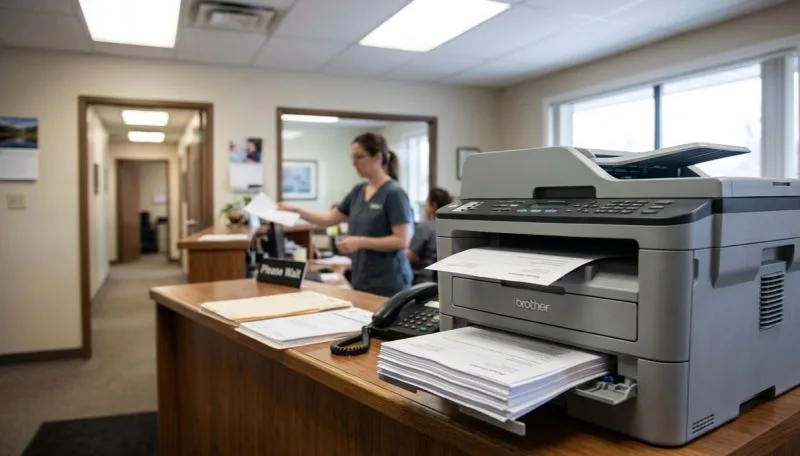
It's tempting to frame this as a technology issue, but it's fundamentally a staffing one. Most clinics have one or two MOAs handling the phones alongside a dozen other responsibilities: checking patients in, processing faxes, entering data into the EMR, managing the schedule, handling walk-ins, and coordinating with the physicians. The phone is one task among many, and it's often the one that gets deprioritized when everything else is urgent.
Hiring more phone staff isn't a realistic solution for many Canadian clinics. Billing revenue doesn't necessarily grow at the pace of labour costs, and a full-time receptionist represents a meaningful ongoing expense plus benefits. For many family practices, that's a significant overhead increase to solve a problem that only peaks for a few hours each day.
The result is a structural mismatch: clinics need phone coverage that scales up and down with demand, but they can typically only afford staffing that's fixed.
What Voice AI Actually Does
Voice AI for healthcare isn't a phone tree. It's not "press 1 for appointments, press 2 for prescription refills." That model has been around for decades and many patients dislike it, because it doesn't actually resolve anything. It just sorts you into a queue where you wait for a human.
Modern voice AI aims to answer the phone more like a person. It listens to what the caller says, interprets the intent, and either resolves the request or routes it appropriately. The underlying technology has improved considerably in recent years. Real-time speech-to-text models transcribe the caller's words, natural language understanding models interpret what the caller needs, and text-to-speech models respond in a more natural, conversational voice rather than a robotic monotone.
At Book Health, our approach to voice is to plan workflows around the most common inbound call types for Canadian clinics. The following are examples of what a voice workflow can be designed to handle, subject to clinic-specific implementation assessment:
Appointment scheduling. A patient calls to book a follow-up. Where schedule access and write permissions are verified for that clinic, a workflow might check availability, confirm the appointment type, and prepare or complete a booking under defined rules. This should not be assumed for any EMR before integration assessment.
Prescription renewal inquiries. A patient calls to check the status of a renewal. A clinic could evaluate a limited workflow that provides an approved status update while routing anything requiring physician review to staff. Available data and permitted responses would need to be confirmed during planning.
General inquiries. Office hours, clinic address, parking information, which insurance plans are accepted, and what to bring for a first visit. These are examples of non-clinical information a clinic might choose to configure in a voice workflow.
Call routing. When a call requires a human, such as a clinical question, a complaint, or an urgent matter, a planned workflow should route the caller according to clinic-approved rules. Transfer behaviour and context-sharing would need to be tested before deployment.
After-hours coverage. A clinic might evaluate a narrowly scoped after-hours workflow for approved information or message intake. Whether it is appropriate, which requests it can handle, and when it must escalate are clinic-specific decisions.
The Metrics That Matter
If you're evaluating voice AI, it helps to decide upfront which metrics you care about and how you'll measure them in your own clinic.
Reasonable metrics to track include average call resolution time (how quickly the patient's need is addressed), escalation rate (what percentage of calls require a human transfer), patient satisfaction (measured through post-call surveys), and call volume handled (how many inbound calls are resolved without human intervention).
Canadian clinics generally don't have the luxury of large call centre teams and can't simply add headcount to the problem. Every minute an MOA spends on the phone is a minute they're not processing faxes, managing the schedule, or handling patient check-ins. The aim of voice AI is not to replace the MOA, but to help with the portion of their workload that's most repetitive and most interruptible, giving them back time in the day.
Rather than promising specific numbers, we think the right approach is to set clear targets with each clinic and measure against them. What "good" looks like depends on your call mix, your patient population, and how the workflow is configured, all of which are part of implementation planning.
Multilingual by Design
This is where the Canadian context creates a genuine opportunity to differentiate.
Many Canadian metropolitan areas are among the most linguistically diverse in the world. In much of the Greater Toronto Area, and in communities such as Scarborough, Markham, Brampton, and Mississauga, a significant portion of patients and their families communicate primarily in languages such as Tamil, Mandarin, Cantonese, Punjabi, or French.
Voice AI solutions built primarily for other markets often focus on a narrower set of languages and may not be tuned for the specific linguistic communities that Canadian clinics serve.
Our intent is to treat multilingual support as a core design requirement rather than an add-on, planned around the communities that Canadian clinics actually serve. Which languages are available for a given clinic, and how well they perform, is part of clinic-specific implementation assessment and deployment planning.
For a clinic where a large share of patients' families speak Tamil, or a practice where Mandarin and Cantonese are common, this isn't a nice-to-have. It's the difference between a voice workflow that fits the patient population and one that doesn't.
The Trust Question
A common question about voice AI is simple: will patients accept it?
Acceptance will depend on the experience, the patient population, and the type of request. Clinics should test whether a workflow is clear, respectful, and easy to leave for a human rather than assume how patients will respond.
The key is transparency. A voice workflow should identify itself as an AI assistant at the start of the call. Patients should always have the option to request a human. And any call that involves a clinical question, a sensitive situation, or anything outside the workflow's defined scope should be transferred to a person.
Trust isn't built by pretending the AI is human. It's built by being faster, more consistent, and more available than the alternative, and honest about what it is.
What This Means for Your Clinic
If you run a Canadian clinic and your phones are overwhelmed during peak hours, if your MOAs are spending much of their day on calls that don't require clinical judgment, or if you're losing patients who hang up and don't call back, voice AI is worth evaluating. The right next step is a clinic-specific assessment of where it could help and how it would fit your existing workflows.
The front door of your clinic shouldn't have to be closed. Thoughtfully designed voice workflows, with humans kept in the loop, can help keep it open.
Availability note: The voice workflows and capabilities described here reflect how we approach front office automation and are subject to clinic-specific implementation assessment and deployment planning. Features, languages, integrations, and timelines may vary and are not guarantees of current availability.